Showing posts with label Hospitalito. Show all posts

Saturday, August 3, 2013

Journey Together

We want to take this opportunity to thank you for your support during our past 3 years in Guatemala and to give you an update on our future plans. Mission work is the way we both personally feel called to follow Christ's example and with the help of Mission Doctors Association (MDA) and you, our family and friends, we are able to fulfill this vision for our lives.   

During our time in Guatemala, we were part of an incredible transition as Hospitalito moved from its temporary location to its new building. We saw Hospitalito grow in its medical staff from two Guatemalan physicians to six and  to begin to address sustainability for the future. We were blessed to have been a part of this history at Hospitalito.  We worked hard, were inspired by many people, tried to live simply, learned more Spanish, and were challenged in ways we did not expect (as life seems to do wherever one is). Our children went to school, made friends, grew, played, laughed, cried and adjusted amazingly well.

After prayer, reflection, and discussion with Mission Doctors, we have decided to continue with MDA for another three year commitment, this time in Cameroon, West Africa. We will be working at St. Martin De Porres Hospital located in Njinikom in the Northwest Province about an hour outside of Bamenda. The hospital celebrated 50 years of service earlier this year. We are looking forward to working along side the staff, especially the Tertiary Sisters of St. Francis of Assisi, who have been running the hospital since it opened. You can find out more about the hospital at http://stmartindeporreshospital.com/index.htm.

We ask you once again to join us on our mission as we try to bridge two cultures and serve those in need. We appreciate any support you are able to give: your prayers, your time, your talents. If you are able to support us financially as well, MDA will designate your tax deductible gift of any size to help cover our direct expenses. You can make your donation online right here (on the right with the big blue button under "Donate to our Mission") or by mail.
Mission Doctors Association
3435 Wilshire Blvd., Suite 1940
Los Angeles, CA 90010

Please indicate that your donation is in support of the Burket Thoene Family Mission.

We are hoping you will continue to follow us on our blog at http://burketthoenefamilymission.blogspot.com/ or you can reach us by email at burketthoene@yahoo.com.

Looking forward to our continued journey together!


Wednesday, July 25, 2012

Pedro and Susana

Pedro, Susana, and their daughter Debra have become good friends during our time here in Santiago.

Susana is the Chief of staff at Hospitalito.  She does an incredible job organizing all of the medical volunteers and their schedules. She also helps review all the patients that are admitted and helps to trouble shoot when problems arise.  

Pedro is one of Hospitalito's finest nurses and is always ready for the challenging patients that present to the hospital.  

Debra is now two and we have really enjoyed watching her grow over the past two plus years.  


Monday, April 2, 2012

Ana

Ana arrived to Hospitalito at about 9 months pregnant.  she had been leaking fluid without contractions and was diagnosed with Premature rupture of membranes.  She was started on medicine to start contractions.

After about 8 hours it was noted that the baby was having slowing of the heart and an exam revealed that the cord had prolapsed (fallen) down in front of the child's head.

This can be a devastating complication of labor with many children not surviving. 

The Doctor on call quickly called the team together and Ana was delivered by an emergency c-section.  All went well and Ana was very happy to see her new child.

Examination of the placenta, after delivery, showed a "Velamentous cord insertion".
This is where the cord inserts abnormally into the placenta and can be very dangerous.  

The first picture is of Ana with her baby, Lydia, her mother and her grandmother.  4 generations !  The second is a picture from their postpartum checkup.

Monday, February 13, 2012

Edgar

Edgar arrived to the Emergency room after a truck backed up and pinned him between the truck and a wall. He had severe chest pain, a thready pulse and oxygen saturation that was dropping rapidly.  On exam he was noted to have no breath sounds on the right side of his chest and you could feel the air bubbling under his skin. He was diagnosed with a pneumothorax and feared to be developing a tension pneumothorax.  
 
This is occurs when the lung is punctured (in Edgar's case by one of his many broken ribs.) Air, from the lung, enters the thoracic cavity and compresses the lung.  The increasing pressure causes the lung to collapse and if the pressure is not relieved can cause collapse of the venous return to the heart and death.  

The ER crew acted rapidly and placed IVs, started oxygen and prepared for a tube thoracostomy. This tube, placed into the chest wall, helps to relieve the pressure that is increasing in the patients chest.  

The tube was placed without difficulty and immediately Edgar was breathing easier and his oxygen saturations increased.  Edgar then was transported to Guatemala City where he spent 8 days in the hospital and ended up having part of his damaged lung removed.

On follow up he was all smiles and very thankful for the care he received. 

Tuesday, January 24, 2012

New Year

The new year has arrived and so an opportunity for reflection.

We have been here for nearly two years and will begin the third year of our three year commitment to Hospitalito and the diocese of Sololá-Chimaltenango.

We have been blessed in so many ways.  

At the Hospital we've been part of a remarkable trans location from the old "interim" hospital -- which was a backpackers hostel -- to the "new" Hospitalito, which should be called "Hospitalote" or grande, allowing plenty of room to grow in the future.  We've seen the Guatemalan doctor staff grow to 4 full time generalists, an obstetrician and now a pediatrician.  Hospitalito has become part of the country's education of pediatricians which places a final year pediatric resident at Hospitalito full time.

We have also seen our role change from primary caregivers to more educational and administrative roles.  In this regard, Brent was recently elected to the board of Hospitalito.

Our children have made friends, attend school locally, and continue to amaze us at how little it takes to make a child happy!

We are so grateful for the many ways our family and friends back home continue to support us -- thank you!

Monday, August 1, 2011

Conception and Cecilia

Concepcion came to Hospitalito at 8:30 AM.  She had noticed onset of strong contractions at 4 AM but could not come to the hospital until she was able to get a ride from her village, Cerro de Oro (about 20 minutes from Hospitalito).  When she arrived, at 8:30 AM, she was dilated to 5 cm and the baby was in a breech position. Concepcion also had a history of a previous Cesarean section in 2003.  She was only 29 weeks pregnant and too early to deliver at Hospitalito.  

Preparations were started to transfer to Guatemala City where there is a neonatal intensive care unit.  She was given medicines to protect the babies brain, slow down the labor and help develop the babies lungs.  After one hour she was 7 cm and it was felt it would be too risky to try to transport her for a 3 - 4 hour journey as she might deliver in the ambulance.  

We then had to decide rather to proceed with a repeat cesarian or deliver vaginally. A cesarean would be the least traumatic to the baby but a 29 week newborn would probably not survive while a vaginal delivery would be the safest for mom.  After consulting with a number of volunteer doctors and even a call to a good friend/obstetrician in the USA it was decided to proceed with a repeat Cesarean.

Brent performed the cesarean section with a visiting Obstetrician, Wayne Weber assisting and his son Nathan (an anesthesiologist) providing the spinal anesthesia.  Baby Cecilia was delivered without difficulty with initial apgars of 3 and 6.  Two other visiting doctors from Ventura, California, Drs. Lepore and Noah, helped to resuscitate Cecilia.  Cecilia then began to have problems breathing and Dr. Nathan intubated and preparations were made to transfer to Guatemala City.  Dr. Noah accompanied Cecelia for the 3 hour trip.
 
Cecelia returned to Hospitalito after 6 weeks on a ventilator and 2 months total in the Neonatal Intensive care unit in Guatemala City. She has a long ways to go but she already has come so far. She is gaining weight and developing well.

Friday, April 15, 2011

Maria

Maria presented to Hospitalito Atitlan with a history of a previous cesarean section about 2 years ago.  She had received some prenatal care at the Central Salud (a government run clinic in town), but she knew that when she went into labor she should come to the hospital. 

When she presented to Hospitalito she was in early labor.  The fetal monitor showed that the baby's heart pattern was "not reassuring" and by Ultrasound the amniotic fluid was too low.  We did not have good dates regarding how many weeks pregnant she was but by a late US and unsure last menstrual period we felt she was somewhere between 36 - 38 weeks.  It was elected to proceed with a cesarean section.  The cesarean section was performed by 2 visiting Obstetricians from Hungary and anesthesia was provided by Brent. We also had a pediatric resident from the states, Kati, who was present to help with resuscitation of Mary's baby if needed.   

Mary's baby was born with an initial low apgar of 4 but the second apgar of 7 was more reassuring but over the next few hours the baby began to have more respiratory difficulty and the oxygen saturation was decreasing and the baby was becoming cyanotic (blue).  The team at Hospitalito worked together to place an endotracheal tube ( a tube in the child's lungs) so that we could breath for the child. The baby was then transferred to Guatemala City, to the government hospital Roosevelt.
 
Mary's baby spent the next 8 days on a respirator and 15 days total in the hospital, and returned to Santiago with mom.


Mary, baby and Kati, the pediatrician who helped with the resuscitation.


Friday, December 24, 2010

Christmas at Hospitalito

We went to the Hospitalito Christmas celebration the other day.  It was at a nearby chalet with a pool and big grassy area.  We played games and groups did skits.  The group that was in charge of the cooking made an incredible meal on an open pit BBQ.  They made grilled chicken, carne asada, chorizo (pork sausage), grilled vegetables, potatoes, salsa made from grilled tomatoes, and guacamole.  It was delicious.  

We don't eat a lot of meat here, so Julianne kept asking for clarification on each meat she was eating..."So this is the chicken's leg and this is cow and this is pig.  I like pig!"

Thursday, December 23, 2010

Preparing for Christmas

We, and especially the kids, are looking forward to Christmas.  The holiday is creeping up on us here without TV and the Christmas sales that start in October (or before).  

The priest emphasized at Mass one day that Christmas does not begin until the 25th.  Now it is Advent, the time of spiritual preparation.  It seems that for many in the US, when Christmas finally comes, the Christmas season ends the same day.  It has been refreshing here.  Of course, the hardest part is that we will spend it without our extended families.
We did buy a small artificial tree which is decorated with a few ornaments, ribbons, and things the kids made. It is just right!  We are planning a Christmas Day dinner here with the volunteers that will be here over the holidays. 
 

P.S. The picture of the tree is not our "small tree" but the tree in the center of town!


Wednesday, December 22, 2010

Cold

Yesterday we woke up and it was 57 degrees inside the house.  (We do not have an outside thermometer, but it was clearly colder outside.)  We never thought we would be cold in the mission field especially after being in Ghana where we were always hot.  
 
It warms up beautifully during the day, but nights and mornings are cold.  We are at 5,105 feet so I guess the cold should be expected, but sure makes it hard to get out of bed in the morning especially with no heat to turn on!

Busy Time

It's been a busy time at Hospitalito.  The first floor of the new hospital has opened after years of work in planning and building.  As much of a challenge as it was to build the new hospital it will be as big of a challenge to run it.  As Hospitalito enters a new era, we are honored to be part of this and hope we are able to help in the challenges that lie ahead.  There are still many sections of the hospital that are yet to be completed and we are awaiting these areas with great anticipation over the next year or years especially the blood bank.

We have had a number of visitors who helped with the opening and moving everything from the old hospital to the new hospital.  Lynn Powe, a nurse, came for the month of November, taking Spanish classes in the mornings and working in the hospital in the afternoons.  She provided much appreciated support to the nursing staff.  We were also able to use Lynn's baby sitting services and enjoyed a dinner out. 

Linda Harris, an obstetrician, and Betty Kaye Taylor, a nurse midwife and ultrasonographer, both from Medford, OR and people who worked with us at La Clinica, came to help set up the obstetrical department.  They did a great job and helped with a number of deliveries and ultrasounds as well.  They brought us many goodies which we are savoring and took us out to a wonderful Thanksgiving dinner at a local restaurant that caters to gringos.  We had everything good and wonderful for dinner.  Julianne kept asking for more of the "chicken with salsa," translation turkey with gravy.

Tuesday, September 14, 2010

Part 4

The trip from Santiago to Solola at any time of the year can be difficult, but especially this time of the year with mudslides and road closures.  Brent is elected to go with Miguel.  Diego, a new nurse to Hospitalito, is assigned to go, as well, and along with Miguel, his parents, the bomberos and Brent, they begin their journey.  

After about 15 minutes, Miguel’s father is dropped off in Cerro de Oro, the village where they live, to tell relatives what is happening and to get money to help pay for their expenses in Solola.  The hospital in Solola is a public hospital so the care is free, but there are costs for the parents to eat, etc.  
 
Every jolt and bump seems to tug on the endotracheal tube and Brent and Diego look at one another hoping not to have to re-intubate on the way, but each tug confirms the nurse’s taping job was excellent.   Brent is providing Miguel’s respirations methodically reciting “squeeze, rest, rest, squeeze, rest, rest...” trying to maintain 20 - 30 breaths a minute and watching Miguel and the pulse oximeter.  The pulse oximeter has been going down 99, 95, 90, 88.  Brent notices the bagging becoming more difficult and gives a dose of albuterol (a medicine that helps to open up the lungs) via the endotracheal tube.  This appears to help as the oxygen monitor increases to 97 again.  The bomberos note another one to one and a half hours to go.

Diego observes Brent looking queazy and offers to take over the ventilations.  There are so many 180 degree turns on the road that you begin to wonder if you are really going forward and not just going in circles.  Brent is reminded of a similar curvy road growing up, the Green Springs, and the many times his father pulled over for him!

Diego sees the oxygen saturations dropping again and a quick look at Miguel shows him moving his mouth, a sign the paralytic agent is wearing off.  Another dose of that, his saturations increase, and he is resting again.  They finally arrived to the Pan American Highway and a direct shot to Solola.

Arriving at the National Hospital in Solola, a team of Guatemalan physicians greet and attend to Miguel and his mother.  The Hospitalito team stays with Miguel and his mother until they feel comfortable with the change over and begin their journey back home.

Miguel did well during his hospital stay there, was extubated (endotracheal tube removed) after three days, and after 8 more days in the hospital he returned home.

Thinking now of our time with Miguel and the people he brought together from different parts of the world, working together for a common good, his name seems fitting -- one who resembles God.

Tuesday, September 7, 2010

Part 3

Morning report is a time to review, with the other doctors working in the hospital, the patients admitted and seen in the ER during the day and night before.  Jennifer quickly reviews the patients and then focuses on Miguel.  Brent arrives at 7:40, a bit late, but in time to hear Miguel's story.  The doctors then go down to see Miguel and the other patients.

Miguel is now breathing 50 times per minute, but his oxygen saturation has again dropped into the 80s.  His pulse is 180 and his lungs are tightening up again.  He is shows signs of tiring and is not able to maintain his oxygen at appropriate levels as his respiratory rate slows.

The team this morning includes doctors from Guatemala as well as from Spain and the United States.  Many specialties are represented including obstetrics, family medicine, and gastroenterology.  They realize Miguel will not be able to keep this up much longer.  They begin working in unison: continuous nebs, a phone consult to a pediatric intensivist in the US, comforting the parents, and preparation for intubation. 

Rapid sequence intubation is a process of giving sequential medications that paralyze the patient and allow for placing a tube into the trachea. This then allows the physician to take over the work of breathing for the patient.

Assignments are given, drugs prepared, high flow oxygen started.  All drug dosages checked and double-checked.

The ER this morning is a cacophony of sounds -- the bubbling of oxygen, the drone of the suction machine, voices of physicians and nurses and the labored breathing of Miquel.

The medicines are given and Miguel stops breathing on his own...... 

Seconds seem like hours during this moment as all attention is focused on placing the tube into the trachea.  

When intubating a patient you are always told to have a backup plan.  What will you do if you are unable to intubate the patient?  The last patient, Brent had intubated, was 6 years ago while working in an ER in Northern California.  Brent ran through the different options in his mind -- bag, bougie, laryngeal mask, needle cricothyroidotomy.

The first attempt is met with coughing, signifying Miguel is not completely paralyzed.  Another dose of the paralyzing agent is given and this time the endotracheal tube is passed without difficulty and taped into placed.  Oxygen is hooked up to the bag and one of the doctors rhythmically compresses the bag which now does all the work of breathing for Miguel. 

Miguel’s oxygen saturation increases rapidly to 99%.  He appears at rest now after working so hard for so long. 

The local volunteer bomberos (firefighters/paramedics) are called and Miguel is prepared for the 2-3 hour trip around the lake to Solola, the national hospital where specialists and ventilators are available.

Monday, August 23, 2010

Miguel: Hebrew origin: one who resembles God, Part 1

It’s the rainy season, but more so this year than in the past few years.  The rain seems relentless at times.  Downpours last for days at a time, a constant drone on the metal roof.  Roads resemble rivers more so than streets.  Mudslides have replaced villages with mud and boulders and there is a general sense from the populace of a heavy coat blanketing all the senses.  But even with all of the rain a "Buenos Dias" is never far from the lips of all we pass by.
 
Miguel’s parents were up with their child late into the night reflecting on the past few days.  It started as a runny nose, followed by a dry hacking cough and then the rapid breathing, each breath an effort to get more air.  They went to the local health center and received various remedies that seemed to help initially, but now, as their child looked up at them with a plea for help and fear of the unknown, they knew he was getting worse.

They say an asthma exacerbation is like trying to breath through a straw, as it worsens the diameter of the straw grows smaller and smaller........

Jennifer had just laid down in bed during a 24 hour in-hospital call.  She’d seen and treated numerous patients that day.  Routine stuff mostly, but now as she laid down at 4 AM she heard the unforgettable "clack, clack, clack" of the tuc-tuc coming down the dirt road to Hospitalito.  At this hour of the day it could mean only one thing -- a patient in need of acute care. 

She gets up before the guardian can knock on her door, fumbling around in the dark in a place that is becoming less foreign each day.  She hears a rooster crow, a dog barking at some unknown nemesis as she puts on her doctor’s coat --loaded with all the “essential” paraphernalia from 15 years of practice.  She grabs her stethoscope, a close friend since her days in medical school, and heads down the stairs to the ER. 

Andrea, the nurse, had already placed oxygen and gotten vitals when Jennifer entered the room.  Miguel’s eyes were bulging and wide with panic as his chest wall heaved with every breath.  Sensing the acuity of the situation, Jennifer questioned, examined, and gave orders almost simultaneously -- pulse oximetry, intravenous access, nebulizer treatments, I.V. steroids.  With treatment, Miguel’s pulse oximetry began to rise from the low 80’s to low 90’s.  His respiratory rate began to drop from the 80’s to 50’s and his lungs began to open up.  He looked a bit better now.  


It was almost 7:30AM and time for morning report. 

Tuesday, August 3, 2010

A Family Affair

We wanted to share with you an article from the Hospitalito, July Newsletter.  

"We don't need Sherlock Holmes to figure out that Brent Burket and Jennifer Thoene don't event fit the description of your usual medical volunteer. The evidence is everywhere upon entering their home: two pairs of kids-sized rain boots, swirly blue and pink, a bookshelf of children's literature, tables loaded with crayons and coloring books, the movie choice of the day is Toy Story 2, and the final clue, a small voice saying, "mama, it's not fair".


So, why do two US physicians with four children under the age of eight, choose to move to highland Guatemala..." read the rest of this article interviewing Brent and Jennifer on the Hospitalito July Newsletter.

Monday, June 21, 2010

Our Days are Full


We started working in the hospital in mid May. We are excited and happy to be seeing patients again and working with the very dedicated staff at Hospitalito.  As always with new work, there are unforeseen challenges.  We studied Spanish for our first three months here so that we could communicate with the staff and patients, but are finding that a vast number of patients speak no or only a little Spanish.  It is hard not being able to communicate with patients directly in their native language.  There is something lost in the history taking, in the patient education given, in the encouragement we want to impart.  Unfortunately, our Spanish is still not proficient, so learning Tz'utujil will have to wait a little longer. 

There are also many things about the culture, the cultural practices and beliefs, and the people’s day to day living that we need to learn.  This is a slow process, because you really don’t know what you want to know until a situation comes up that provokes questions.  Someone can’t sit down and tell you that these are the differences between our culture and their culture.  Some things may seem so natural for one culture that it is hard to even explain what provokes a particular belief or practice.  For example, several patients have asked if bathing in cold or hot water will affect their medical condition, but we have not yet been able to figure out what concern perpetuates this belief.
  
Our days are full.  We’ve been busy balancing the new work schedule, family, and involvement with the church.  The kids seem unfazed by it all and wake up each day with smiles on their faces and ready for a new day (unfortunately usually before 6AM).  We have no after school activities, no TV, etc., yet we are busy.  Our two first graders go to school from 7:30 until 12:30.  By the time they get home and we eat our main meal about 1 or 1:30PM and they have a little time outside to play, it is 2:30.  Just enough time for a couple of hours of homeschooling, then it is dinner, a shower, reading and bedtime.

All the activities of daily living are very time-consuming and less so for us than for most of the local people because we are very fortunate to have a washer, refrigerator, and gas stove (so we don’t have to have gather, cut, and burn wood for cooking).  Shopping is an almost daily necessity as we can only carry so much home at a time.  Meal preparation is very labor-intensive as almost everything needs to be made from scratch and raw fruits and vegetables need to be prepared specially.   

Christopher and Elizabeth continue at the local Catholic School.  They are learning Spanish, the local Mayan language, Tz'utujil, and a little English as part of their school curriculum.  They had exams recently and while we were studying, they had some practice tests at home.  In one day, they took tests in all 3 languages.  Christopher thought that this was very unfair :).  We’ve participated in a number of school events including a field trip to the beach on another part of the lake (we paid for this thinking it was going to be at a local beach and then the day before found out it was a boat trip away, after which the teacher allowed Brent to tag along as a chaperone), Mother’s day celebration which was a huge, wonderful celebration complete with tamales as a treat for all the mothers, and a school birthday celebration.  Christopher’s birthday was at the end of May and so we brought a little snack for the class.  We were completely surprised when Christopher was inundated with gifts and hugs from his classmates.  He received a couple of toys, but most of the gifts were completely practical: socks, towels, cups, bowls.  This was so generous and thoughtful as we are sure these students’ families do not have money to spare. 

Julianne and Nicholas are both in a local preschool two days a week and really enjoy their time with the other kids in the community.  Many little art projects are covering the walls in our house and are providing creative decorations.  


Peace
Brent, Jennifer, Christopher, Elizabeth, Julianne and Nicholas

Thursday, April 15, 2010

Semana Santa

We hope you and your loved ones are doing well.

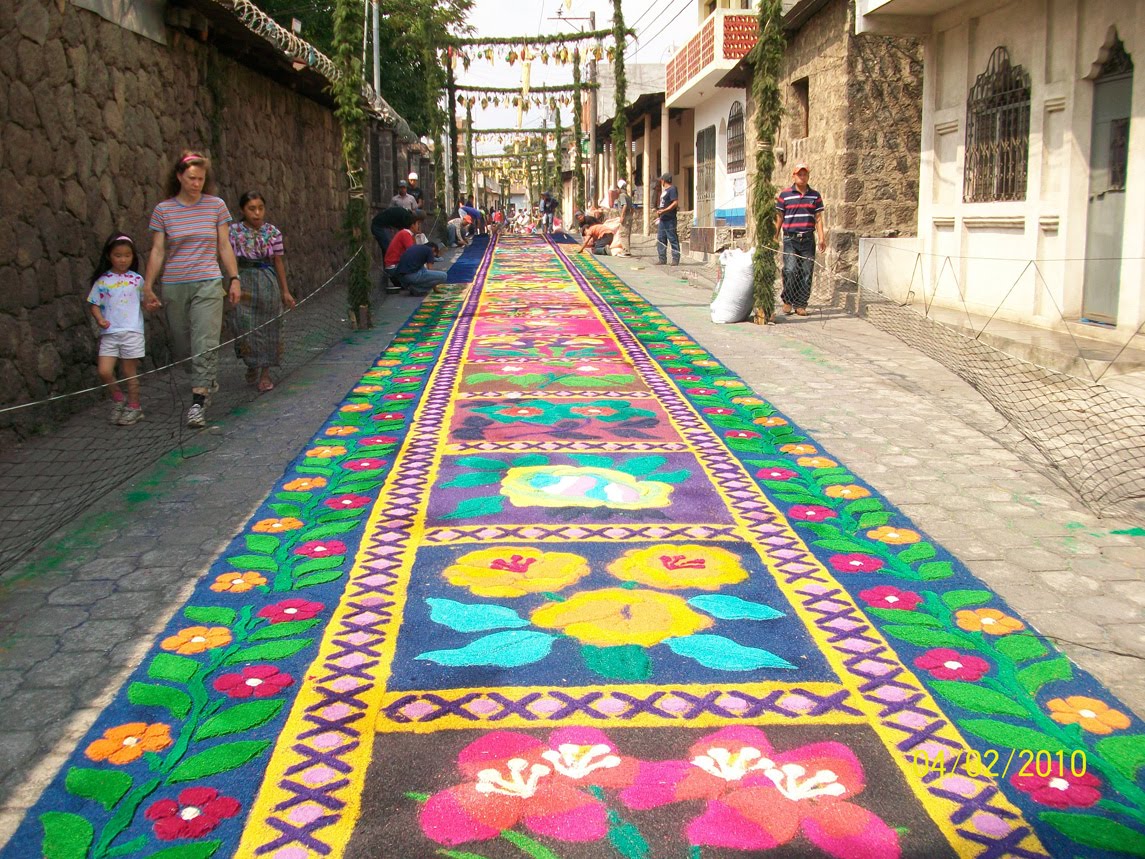
There has been a lot of activity in Santiago. The Easter week or “Semana Santa” is the largest celebration of the year here. It was a special time seeing the community come together in preparation for this holiest of celebrations.

The schools all let out the week before Easter and businesses worked half a week to begin preparing. There were many preparations going on, but the most beautiful was the making of “alfombras” or carpets. These are various religious images or images of flowers painstakingly made entirely out of brilliantly colored saw dust, colored gravel, flowers, and/or plant parts that almost fill the width of the streets. The alfombras cover about 10 blocks surrounding the church. On Good Friday, at least 60 men carrying a large platform with a figure of Christ on it, process through the streets over these alfombras. The procession is very slow. It starts around 3 pm on Good Friday and we heard continues throughout the night until it arrives back at the church at dawn. Our children lasted about 1 1/2 hours, not all night!

Christopher and Elizabeth enjoyed their week off from school and couldn’t figure out why we wanted to continue home schooling. They received their first report card and did very well with their lowest scores in English (we still can’t quite figure that one out) and Physical Education. Julianne also had a week off from preschool but kept asking when she could go again. Nicholas celebrated his 3rd birthday April 5 (our first family birthday in Guatemala). We enjoyed hot dogs, a cake, and playing with friends.

We moved into our permanent residence last week and we are excited to be settling down and not living out of suitcases. Brent and Jennifer continue in language school and we are finding language acquisition much more challenging than for our children. We will begin working at Hospitalito in mid May and are looking forward to working with and for the people of Santiago.

Peace and Love,

Brent, Jennifer, Christopher, Elizabeth, Julianne and Nicholas

Friday, February 26, 2010

Our Life in Santiago Atitlan Begins...

We arrived in Santiago Atitlan on February 9, 2010.  After a night flight and then a 3 hour drive to Santiago, we were warmly greeted by many of the staff at Hospitalito.  They graciously helped unload our many heavy bags and carried them down the path to  the house where we will be living for the next 2 months.  The staff had a welcome lunch for us the next day where we had a delicious local dish called caldo de pollo (chicken soup) and tamalitos, which are little tamales without the filling.

The children are doing great, exploring their new surroundings and making new friends. Christopher and Elizabeth have started 1st grade at the local Catholic school.  It’s amazing to see them go to school everyday without a complaint nor a worry that they don’t speak Spanish and that the teacher doesn’t speak any English.  Kids are so adaptable!  Julianne is attending preschool two days a week and is enjoying that.  To our surprise, she asked the other day when we were going to get to Guatemala.  When we told her that this is Guatemala, she just said “Oh.”  Nicholas says “Hola” to everybody with such a big infectious smile that all seem to walk away with a bigger smile.  Jennifer and Brent have started language school and are finding out how much they need to learn in the next few months.  

We will continue in language school until mid May and then we will start working at Hospitalito. The hospital is in the process of being rebuilt (see previous blog). It appears that the hospital is functioning well at the interim location, but you can sense the excitement surrounding the building of the new hospital with a projected opening date in late summer or early fall.

The people have been very friendly and helpful.  They really love children and are curious about our diverse family.  

The area is beautiful and the climate temperate.  The yard in the house we are staying at has evergreens and many exotic, tropical flowers, as well as birds.  The kids love running up and down the long grassy area in front of the house playing make-believe games of kings and queens and rescue.  No toys necessary, just one big stick that we try not to let Nicholas get a hold of.  There is also a great tree for climbing.

We go to the local market several times a week.  There is a good variety of fruits and vegetables, beans, rice, and, of course, tortillas.  The tortillas are made by hand out of masa right while one watches and then cooked on a stone griddle.  They are best eaten hot, right on the street!  The bananas, pineapple, cantaloupe, mangos, and papaya are all as sweet as can be and the avocados are the best and biggest we’ve ever seen.  We have splurged on peanut butter and cheese which are not at all a local staple, but can be found in town.

Walking or riding a tuc-tuc is the most common mode to get somewhere.  The kids love riding in tuc-tucs: no seatbelts, open air, holding on to the edge of your seat as you wiz dangerously close to other vehicles.  Click here for a video of a tuc-tuc ride in Santiago. 

The church is very alive here.  There are three masses on Sunday.  Two in the local language,Tz'utujil, and one in Spanish.  The Spanish Mass had over 800 people and was standing room only, the overflow extending out the back of the Church. 

The Tz'utujil dress is very colorful with intricate patterns of birds and flowers in purples, reds, greens, and yellows.  This along with the music and singing made for a very exciting mass that even Nicholas enjoyed until halfway throught the homily when he was tempted (as Christ was tempted in the Gospel this week) to get off Daddy’s lap and make a break for the back of the church.  The other children did surprisingly well at Mass eventhough it was a bit longer than at home.

We want to thank our families and friends for all their support, especially over the last few months, to help make this transition go as well as it has.  

We hope all is well with you and your loved ones.  

Peace and Love,

Brent, Jennifer, Christopher, Elizabeth, Julianne, and Nicholas :)  

Wednesday, February 10, 2010

Arrival

EXCITING NEWS!

We were so excited about the arrival of the Burket Family, that we sent Aklax to the airport ONE DAY EARLY!  Brent and Jennifer have arrived to volunteer at the Hospitalito for THREE YEARS. They are both family practice physicians with the ability to perform cesareans.

On the left in the group foto are Christopher, Brent, Jennifer and Julianna Burket. Aklax is holding Elizabeth and Juan Manuel has little Nicholas. (yes, four small children!) The staff was so eager to meet the new family that they arrived to welcome them, and to help carry luggage.
We are very happy that they have arrived! 

Mission Doctors is the organization that facilitated their volunteer time with HA. It was September 2007 when Dr. Brent arrived with Mission Doctor’s director Elise Frederick. We have been patiently awaiting his return.